As an Alzheimer’s Los Angeles Ambassador, longtime estate-planning attorney and former family caregiver, Attorney Collins challenged families to reconsider what preparedness for cognitive decline really means—and why the time to build protections is before a crisis begins.
On Saturday, June 6, 2026, one of the most difficult questions surrounding early cognitive decline came into focus:
How do we protect someone we love without taking away the independence, dignity and voice we are trying to preserve?
It was against that backdrop that Attorney Collins, founder of Collins Law Group, delivered a keynote presentation during the Alzheimer’s Los Angeles Early Memory Loss Conference, a free virtual educational program created for individuals experiencing early memory loss, mild cognitive impairment and early-stage dementias, as well as their families, friends and care partners.
The four-hour conference brought together perspectives spanning legal and financial planning, brain health, medical research, practical approaches for living with memory changes and, importantly, the lived experiences of people navigating early memory loss themselves.
For Attorney Collins and Collins Law Group, however, participation in the conference represented something larger than a single speaking engagement.
Earlier this year, Attorney Collins and Collins Law Group became official Ambassadors for Alzheimer’s Los Angeles, strengthening a relationship centered on education, advocacy, preparedness and support for individuals and families affected by Alzheimer’s disease, dementia and cognitive decline.
That commitment made Collins’ keynote particularly fitting.
Her presentation, “When Memory Changes, Risk Changes,” explored a part of cognitive decline that families can easily overlook:
Memory loss can change financial risk long before a family recognizes that it is facing a financial crisis.
And from that premise, Collins built a practical framework for recognizing vulnerability earlier, organizing family protections more intelligently and preserving dignity throughout the process.
A Different Way to Think About Cognitive Decline
Families understandably associate dementia with memory.
They watch for repeated questions.
Missed appointments.
Misplaced belongings.
Difficulty remembering names.
Problems finding words.
Collins asked families to widen that lens.
Cognitive decline can also affect judgment, attention, reasoning, sequence tracking, confidence and financial decision-making.
A person may continue to carry on a normal conversation. They may still live independently. They may appear socially engaged and capable.
Yet underneath that outward appearance, some of the mental safeguards that allow a person to pause, compare information, recognize inconsistencies and resist manipulation may already be changing.
That distinction can have enormous consequences.
Because the first visible warning of cognitive decline may not necessarily occur inside a physician’s office.
Sometimes, it appears in a bank account.
An unusual withdrawal.
Repeated charitable donations.
A sudden wire transfer.
An unexpected gift.
A new online relationship.
A frantic request for money.
An unfamiliar person suddenly gaining influence.
Or secrecy surrounding finances where secrecy never existed before.
Collins reframed these events not merely as isolated financial mistakes, but as possible cognitive-risk signals.
Her central thesis was direct:
Fraud prevention is dementia care.

That idea became one of the intellectual foundations of the presentation.
Because when cognition begins to change, families can no longer afford to treat medical care, legal planning, financial oversight and caregiving as entirely separate conversations.
Increasingly, they become components of the same system of protection.
The Dangerous Gap Between Independence and Recognized Incapacity
One of the most consequential ideas Collins explored involved a weakness in the systems surrounding older adults.
Most systems are designed to respond to recognizable events.
Banks monitor transactions.
Doctors evaluate patients during individual appointments.
Legal systems establish standards surrounding capacity and authority.
Families understandably begin with the presumption that a parent, spouse or loved one should retain as much independence as possible.
Scammers operate under an entirely different timetable.
They do not wait for a diagnosis.
They do not wait for a family meeting.
They do not wait for a physician to declare that something has changed.
They do not wait for legal incapacity.
And they certainly do not require a victim to have advanced dementia.
That creates what Collins effectively identified as a dangerous gap between functioning and recognized impairment.
A financial institution may see only a transaction—not the hour-long telephone conversation involving manipulation that preceded it.
A physician may see a patient for a limited period and never witness changes in financial judgment occurring at home.
Adult children may notice something unusual but hesitate to intervene because they want to respect a parent’s autonomy.
Every individual response can be understandable.
But collectively, they can leave a vulnerable person exposed.
The larger strategic problem is straightforward:
Families often wait for certainty. Exploiters only need vulnerability.
Those two moments rarely occur at the same time.
And the space between them is where preventable harm can occur.
Why Modern Scams Become More Dangerous When Cognition Changes
Collins also challenged outdated assumptions about fraud.
Modern financial exploitation is often far more sophisticated than an obvious suspicious email.
It is engineered around human behavior.
Urgency.
Authority.
Fear.
Familiarity.
Isolation.
Romance.
Technical confusion.
Secrecy.
Repetition.
A person experiencing early cognitive decline is not suddenly unintelligent or incapable.
That was an important distinction throughout Collins’ presentation.
Instead, the cognitive functions involved in evaluating competing information, recognizing manipulation, remembering earlier warnings, resisting emotional pressure and verifying whether something is legitimate may begin to change.
A skilled scammer can exploit exactly those vulnerabilities.
They create an emergency.
They discourage outside verification.
They establish artificial authority.
They demand immediate action.
They isolate the target from the people most likely to intervene.
And they frequently weaponize embarrassment afterward so the victim does not disclose what happened.
The response, therefore, cannot simply be:
“Tell Mom not to answer strange phone calls.”
Families need systems.
From Estate Documents to a Family Protection Architecture
This was where Collins’ keynote moved beyond identifying the problem and into something more consequential:
How should families actually prepare?
Traditional estate planning understandably addresses defined legal questions.
Who manages finances if someone becomes incapacitated?
Who makes health-care decisions?
Who manages a trust?
Who inherits property?
Who has authority when an individual can no longer act?
Those questions remain fundamental.
But cognitive decline presents a different strategic challenge because dementia is frequently a gradual-change problem rather than a single-event problem.
Collins therefore introduced an important planning principle:
Plan for cognition, not just crisis.
Dementia-aware planning asks different questions.
How can good financial judgment be supported before complete incapacity?
Who becomes the trusted second voice when something unusual happens?
Who is watching for behavioral changes?
Who can review financial accounts?
When should additional authority become appropriate?
How will siblings communicate?
What happens if family members disagree?
Who contacts the bank?
Who contacts the attorney?
What happens when someone begins receiving suspicious telephone calls every afternoon?
And perhaps most importantly:
How can protection increase while the individual’s dignity and participation remain intact?
That represents an important evolution in the way families can think about estate planning.
The objective is no longer simply to own the correct legal documents.
The objective becomes creating an operating system for changing capacity.
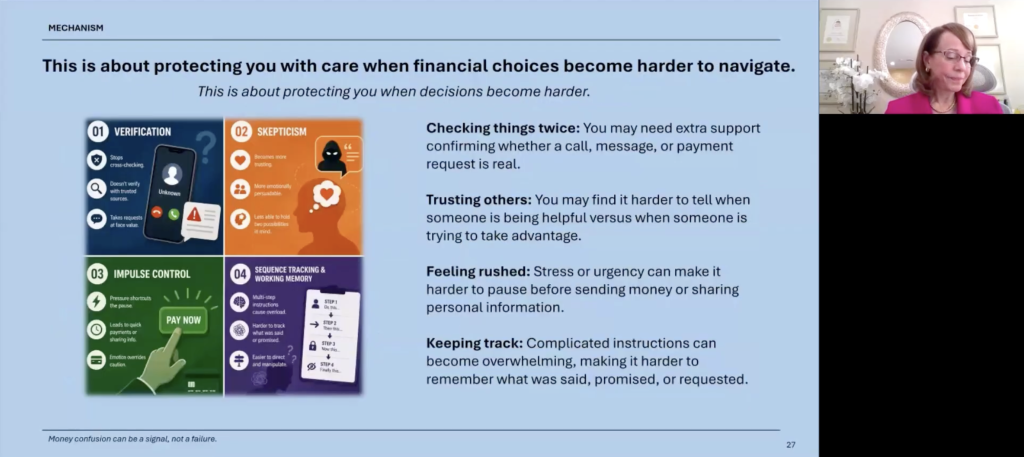
Building a “Protection Stack”
Collins translated that concept into a layered system of safeguards—a protection stack rather than one isolated solution.
Depending on an individual’s circumstances, those protections may include:
- A trusted contact or designated second voice when unusual financial activity occurs
- Appropriate account monitoring or limited financial access
- A durable financial power of attorney structured with the realities of cognitive decline in mind
- Advance health-care planning
- Regular review of statements and recurring transactions
- Thoughtful management of passwords, devices and telephone settings
- Credit-monitoring or credit-freeze strategies where appropriate
- A clear system for family communication
- And a predetermined response plan when suspected exploitation occurs
The strategic insight is deceptively simple:
See Attorney Collins walk through each layer of the Protection Stack in the recorded session.
Legal documents are necessary—but documents alone do not create a functioning protection system.
A power of attorney sitting in a drawer does not notice an unusual withdrawal.
A trust does not recognize that a stranger has called eight times this week.
An advance health care directive does not tell siblings how to communicate with one another.
And even the best estate plan cannot prevent family confusion if no one understands their respective role.
Effective planning requires something beyond documentation.
Families need to know:
Who watches?
Who verifies?
Who communicates?
Who has authority?
And what happens next?
When the Threat Is Closer to Home
Collins also addressed an uncomfortable reality.
Not every threat is digital.
Not every exploiter is a stranger.
Financial exploitation can sometimes involve individuals who already have proximity or access to the older adult.
A family member.
A caregiver.
A companion.
A neighbor.
A newly trusted acquaintance.
Warning signs can include unexplained withdrawals, unusual reimbursements, pressure to sign documents, missing property, interception of mail, increased isolation or sudden control over someone’s telephone, appointments or financial information.
That requires families to rethink another assumption:
Trust and access are not the same thing.
Someone can be trusted personally while still requiring appropriate boundaries, transparency and documentation when significant assets or decisions are involved.
And there is another threat families often overlook:
Their own disorganization.
Family Governance Is Part of Dementia Planning
One sibling handles financial accounts.
Another attends medical appointments.
Someone else has copies of the estate-planning documents.
Another relative knows all the passwords.
One adult child begins “handling everything.”
Everyone means well.
But no one possesses the entire picture.
That fragmentation can become dangerous.
Collins’ framework made clear that unclear authority, inconsistent communication, commingled funds, informal password sharing and undefined responsibilities can magnify cognitive and financial vulnerability.
In organizational terms, this is a governance problem.
Strong organizations establish:
decision rights, accountability, information flow and escalation procedures.
Families facing cognitive decline increasingly need their own compassionate version of those same systems.
Who has authority?
Who receives information?
What should require a second opinion?
What gets documented?
What happens when there is disagreement?
Clear roles reduce conflict.
Transparency reduces suspicion.
Documentation reduces confusion.
The objective is not to turn a family into a corporation.
It is to ensure that when circumstances become difficult, the family is not simultaneously trying to invent its decision-making structure.
The Hardest Balance: Protection Without Humiliation
For all of the keynote’s discussion surrounding legal safeguards, fraud and financial vulnerability, Attorney Collins repeatedly returned to something far more human.
Dignity.
A person may need greater assistance while still deserving respect, explanation and meaningful participation.
There is an enormous difference between saying:
“You can’t handle this anymore.”
and saying:
“I’ve noticed a few things that concern me. Can we look at them together?”
Tone matters.
Pacing matters.
Transparency matters.
Autonomy matters.
A loved one who feels ambushed, infantilized or humiliated may become more secretive rather than less.
They may resist assistance.
They may hide mistakes.
And in some cases, they may become more emotionally attached to the outsider who appears to validate their independence.
Collins reduced the principle to four words:
Protection must preserve dignity.
Effective protection for early cognitive decline should therefore be gentle, layered, transparent, documented and dignity-preserving.
The goal is not one dramatic intervention.
It is a support architecture that evolves as circumstances evolve.
And that philosophy aligned closely with the purpose of the Early Memory Loss Conference itself, which centered not only caregivers and professionals but individuals who are themselves living with early memory loss.
People experiencing cognitive change should remain participants in conversations about their futures—not merely the subjects of those conversations.
Attorney Collins Brought More Than Four Decades of Legal Experience—She Brought Lived Experience
Attorney Collins’ perspective carried another dimension.
She was not speaking only as an estate-planning attorney.
She was speaking as a daughter and former caregiver who spent approximately a decade caring for her own mother while dementia changed their family life.
That experience transformed what could have been a technical discussion into something much more immediate.
Because dementia is not experienced as a legal outline.
It happens at kitchen tables.
Through bills.
Appointments.
Phone calls.
Repeated conversations.
Changing routines.
Questions about driving.
Questions about money.
Questions about authority.
Questions about whether a parent is still safe.
And the extraordinary emotional difficulty of trying to protect someone while continuing to recognize that person as the parent, spouse or adult they have always been.
For Collins, the lesson was clear:
The best planning frequently happens before crisis—when families still have time, choices and the ability to involve the person whose future is being planned.
Earlier Planning Preserves Something More Valuable Than Money: Options
Timing ran through virtually every aspect of Collins’ keynote.
Beginning legal and financial conversations earlier provides individuals with greater opportunity to articulate their wishes, select trusted decision-makers and remain actively involved in shaping their future.
Depending upon an individual’s circumstances, planning can include reviewing or establishing:
- A revocable living trust
- Durable financial powers of attorney
- Advance health care directives
- Beneficiary designations
- Asset ownership
- Successor trustees and other fiduciaries
- Plans for future care and support
- Instructions reflecting personal priorities and values
- Appropriate financial monitoring and communication systems
The strategic benefit of early planning therefore extends far beyond avoiding probate.
Early planning preserves optionality.
It gives families time to make deliberate choices rather than emergency choices.
It allows safeguards to be introduced gradually rather than suddenly.
It gives attorneys, physicians, financial professionals and family members a better opportunity to coordinate.
And most importantly, it allows the person whose future is being discussed to remain actively involved in designing it.
What To Do When Something Feels Wrong
Even excellent planning cannot eliminate every risk.
Families therefore need an emergency procedure.
Collins’ presentation offered a memorable framework:
Pause. Preserve. Call. Freeze. Document. Report.
Pause before sending additional money.
Preserve emails, messages, telephone numbers, receipts and other evidence.
Call the appropriate financial institutions and trusted professionals.
Freeze accounts or credit where appropriate.
Document what occurred.
Report suspected fraud through appropriate channels.
Why does having a predefined process matter?
Because the first hours after financial exploitation is discovered can otherwise disappear into panic.
Embarrassment.
Family disagreement.
Uncertainty.
Blame.
Or the assumption that nothing can be done.
A process replaces some of that chaos with action.
Watch Attorney Collins explain this framework and when to use it.
From Reaction to Readiness
Perhaps the greatest contribution of Collins’ keynote was the behavioral shift it asked families to make.
The traditional pattern often looks something like this:
Notice obvious decline → Wait for certainty → Experience crisis → Seek help → Establish control.
Collins offered a different model:
Notice subtle changes → Begin conversation → Organize the family → Establish safeguards → Monitor changing needs → Increase support proportionately.
That distinction is profound.
It moves families:
From crisis management to risk management.
From isolated documents to integrated systems.
From vague responsibility to family governance.
From fear to preparedness.
And perhaps most importantly:
From protecting assets alone to protecting independence, voice, family stability and dignity.
A Partnership Built Around Education and Preparedness
Attorney Collins’ keynote also represented a continuation of the broader relationship between Collins Law Group and Alzheimer’s Los Angeles.
Earlier in 2026, Attorney Caprice L. Collins and Collins Law Group became official Ambassadors for Alzheimer’s Los Angeles, supporting the organization’s mission through community education, awareness and meaningful resources for families navigating Alzheimer’s disease, dementia and cognitive change.
For Collins Law Group, that role reflects a natural extension of decades spent helping families prepare for aging, incapacity, caregiving and legacy.
The legal and medical worlds cannot operate in isolation when cognitive decline enters a family.
Neither can families afford to wait until the moment of crisis to begin understanding their options.
Education is therefore not secondary to good planning.
Education is where good planning begins.
Watch the Complete Early Memory Loss Conference

For individuals, caregivers and families who were unable to attend—or who would like to revisit the presentations—the entire June 6 Early Memory Loss Conference can be viewed online.
The full program includes Attorney Collins’ presentation as well as important discussions surrounding brain health, medical research, memory changes, caregiving and the lived experiences of individuals navigating early cognitive decline.
Watch the Complete Early Memory Loss Conference
We encourage families to watch the program together and use it as a starting point for conversations that may otherwise be difficult to begin.
Continue Learning: Resources From Collins Law Group
Collins Law Group also wants families to leave this conversation with more than awareness.
We want them to leave with tools.
Download the Collins Law Group Early Memory Loss Planning Brochure
Collins Law Group has prepared a companion brochure highlighting many of the important concepts Attorney Collins addressed during the conference, including the importance of early planning, recognizing changing financial and decision-making risks, protecting independence and establishing legal safeguards before a crisis.
[DOWNLOAD THE EARLY MEMORY LOSS PLANNING BROCHURE]
Download the Early Cognitive Decline Awareness & Action Guide
Families can also download our practical Early Cognitive Decline Awareness & Action Guide, created to provide specific tools and information for recognizing potential changes and beginning appropriate conversations.
The guide is designed to help individuals and families think more intentionally about:
- Early cognitive and behavioral warning signs
- Financial changes that may warrant closer attention
- Fraud and exploitation vulnerability
- Family communication
- Trusted contacts and decision-makers
- Powers of attorney and health-care planning
- Financial monitoring
- Important documents and information families should organize
- Questions to discuss with physicians and qualified professionals
- Steps families can take before an emergency occurs
[DOWNLOAD THE EARLY COGNITIVE DECLINE AWARENESS & ACTION GUIDE]
These materials are designed as educational starting points—not as substitutes for individualized legal, financial or medical guidance.
The Message Families Took Home
Collins closed her presentation not by leaving families fearful of cognitive decline or financial exploitation.
She returned to purpose.
Protect memory.
Protect money.
Protect dignity.
And then came a sentence that perhaps best summarized the philosophy behind the entire keynote:
“When memory changes, love must become more organized.”
Love may already exist in abundance.
The difficult part is converting love into action.
Into conversations.
Into documents.
Into trusted relationships.
Into financial safeguards.
Into defined responsibilities.
Into medical planning.
Into systems that continue functioning when circumstances become uncertain.
And into protections implemented early enough—and respectfully enough—to preserve what matters most.
That was the larger impact of Attorney Caprice L. Collins’ keynote at the 2026 Alzheimer’s Los Angeles Early Memory Loss Conference.
She did not simply ask families to prepare for dementia.
She challenged them to rethink what preparedness actually means.
Not control.
Not panic.
Not waiting until every doubt has disappeared.
But thoughtful, proportionate and coordinated action while choices remain available.
Because great estate planning is not simply about protecting what someone leaves behind.
It is also about protecting how they live, who speaks for them, what they value, the independence they can retain and the dignity they deserve throughout the journey.
And when memory begins to change, making those decisions early may become one of the most consequential acts of love a family can undertake.
Learn More and Begin the Conversation
If memory changes have raised questions about your family’s estate plan, powers of attorney, advance health care directives, financial protections or long-term planning, Collins Law Group welcomes the opportunity to help you better understand the options available.
Collins Law Group
3330 W. Manchester Blvd.
Inglewood, California
Call (310) 677-9787
Watch the June 6 Early Memory Loss Conference:
Download the Early Memory Loss Planning Brochure

Download the Early Cognitive Decline Awareness & Action Guide

This article and the accompanying educational materials are provided for general informational purposes only and do not constitute legal, medical or financial advice. Every individual and family circumstance is different. Individuals should consult qualified legal, medical and financial professionals regarding their particular circumstances.

- The Family Compound Can Become a Family Trap - October 15, 2026
- The Great Wealth Transfer Can Still Become a Family Mistake - October 15, 2026
- The Inheritance Your Children Are Counting On May Not Be There - October 14, 2026
